
Architecture Internship in Thessaloniki Inspires Ideas for Reviving Karatasou Park Buildings
Loan , ESAI EN ROI Interns || Jean Garnier || FRANCE
Erasmus+ Vocational Education & Training 07/06 to 04/07/2026

Abandoned buildings often sit quietly in public parks, but they are never empty of meaning. They hold memory, questions, and the possibility of a new use that serves the local community.
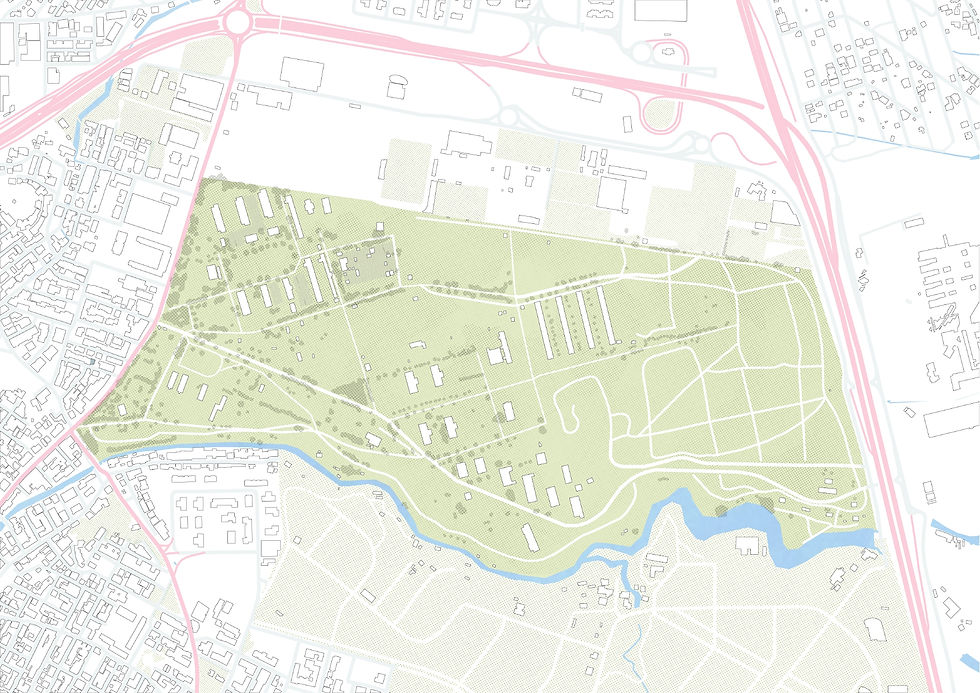
This was the spirit behind a recent architecture internship in Thessaloniki, where two students architecture assistants from a professional school in France joined the work of ESAI EN ROI in Greece. During his stay, he offered his time, skills, and fresh perspective to support activities connected with Karatasou Park, a local green space with buildings that invite careful thought about their future.
The internship focused on positive contribution rather than final decisions. Under the supervision of three project mentors, the students explored ideas for how abandoned buildings in the park could be transformed, reused, and discussed in a practical way. The files and proposals produced during this period will be kept by the organisation for future use in Board discussions related to Karatasou Park and its potential development.
Students placement rooted in public benefit
The placement brought together learning, service, and local interest. The students did not arrive only to observe. He came to Thessaloniki to offer practical support as an architecture assistant, working within the frame set by ESAI EN ROI and its mentors.
For an architecture student, this kind of experience matters because it connects design education with real places. In a classroom, abandoned buildings can appear as drawings, models, or case studies. In Karatasou Park, they are physical structures, set inside a living public space. Their condition, surroundings, and possible future use all need attention.
The internship also gave the organisation a useful outside view. A student trained in France can bring different references, habits, and design questions. Those differences do not replace local knowledge. They can help open the conversation.

The aim was not to impose a finished plan. The more useful task was to gather ideas, organise visual and written material, and give the Board something concrete to review when the topic returns to discussion.
That balance made the internship meaningful. It supported the students' growth, while also leaving behind material that ESAI EN ROI can revisit.
Why Karatasou Park was a valuable learning ground
Karatasou Park is more than a backdrop for architectural thinking. It is a public place where any idea about buildings must sit beside trees, paths, daily walks, informal activity, and community expectations.
That makes it a strong setting for an architecture internship. A park asks different questions from a dense city street or a private development site. The first question is not only what can be built or repaired. It is what kind of use would feel appropriate in a public green space.
The abandoned buildings in the park raise several design questions:
How can old structures gain new purpose without losing their character?
Which uses would support the park instead of taking it over?
How can simple interventions make a building safer, clearer, or more useful?
What kind of future activity would serve people of different ages and interests?
How can the organisation prepare ideas without rushing into decisions?
These are not abstract questions. They shape the way an architect looks at walls, openings, access points, shade, paths, and the relationship between inside and outside.
For the students, the park offered a real lesson in restraint. Good architecture in this context does not always mean adding more. Sometimes it means reading what is already there and finding careful ways to make it useful again.
How the three mentors shaped the work
Supervision was central to the internship. The students worked under the guidance of three project mentors, which helped turn his contribution into a structured process rather than a loose collection of ideas.
Each mentor supported the work from a project perspective. Together, they helped the students understand the local context, frame the questions around the abandoned buildings, and keep the material useful for future organisational review.
Mentorship also helped maintain a responsible approach. Public space projects can quickly become too broad. A student may see many possibilities at once, such as cultural rooms, workshops, storage areas, small community hubs, educational corners, or art spaces. The mentors helped filter those thoughts into ideas that could be recorded, discussed, and developed later.
This kind of guidance matters because architecture is not only about imagination. It is also about listening, documenting, comparing options, and respecting decision-making processes.
The mentors helped the students focus on several practical layers:
The existing condition of the buildings
Their relationship with the park environment
Possible future uses
The level of intervention each idea might require
How to present ideas clearly for Board review
Through this process, the internship became a shared exercise. The students contributed fresh energy. The mentors gave continuity, local understanding, and project discipline.
Ideas for transforming abandoned buildings
The students' main contribution was to help imagine how the abandoned buildings in Karatasou Park could be transformed. This did not mean producing final architectural plans ready for construction. It meant offering ideas that can support discussion and help the organisation think about future directions.
The strongest ideas for abandoned park buildings often begin with adaptive reuse. Instead of treating old structures as problems to remove, adaptive reuse asks whether they can serve a new purpose with care.
In a park setting, possible ideas may include:
Small cultural or educational spaces
Rooms for environmental activities
Flexible areas for community workshops
Support spaces for park-related events
Places for exhibitions linked to local history, ecology, or civic life
Light-touch interventions that improve access, safety, and visibility
The value of such ideas lies in their ability to start a conversation. A Board cannot discuss a future clearly if the topic remains vague. Drawings, notes, references, and design thoughts give people something to examine.
The students helped create that foundation. Their files can serve as a record of possibilities, not as a fixed instruction. This is useful because public interest projects often move in stages. A first idea may later become a feasibility discussion. A feasibility discussion may lead to consultation, partnerships, funding exploration, or a more detailed design brief.
The material now kept by ESAI EN ROI can support that path when the time is right.

The value of files kept for future Board discussions
One of the most useful outcomes of the internship is also one of the quietest: the organisation kept the files for future use.
This matters. In community and park-related work, ideas can disappear if they are not recorded. A conversation may be inspiring, but without clear files, it becomes hard to return to the same point later. Documentation gives continuity.
The files from the internship can help ESAI EN ROI in several ways.
They can support memory. If the Board returns to the topic months later, the material can remind members what was observed and proposed.
They can support comparison. Different building uses can be reviewed side by side, with attention to benefit, complexity, and fit with the park.
They can support planning. Even early ideas can help shape future questions, such as what information is still missing, what permissions may be needed, or which partners could be involved.
They can support dialogue. Visual material often makes discussion easier because people can respond to something concrete.
This does not mean the Board must accept every idea. It means the discussion can begin from a better place. Instead of starting with only a general wish to revive abandoned buildings, the organisation now has collected material that can be reviewed with more clarity.
A positive exchange between France and Greece
The internship also carried a wider value because it connected architectural education in France with civic activity in Thessaloniki.
Such exchanges are most useful when they remain grounded. A visiting student should not treat a local place as a design exercise detached from daily life. In this case, the work was tied to ESAI EN ROI, supervised by mentors, and aimed at supporting future discussion around Karatasou Park.
That structure made the exchange respectful. The student brought his training and curiosity, while the organisation provided the local frame. The result was a contribution that belongs to a longer process.
For the student, the experience likely offered lessons that cannot be fully taught in a studio:
How to observe public space patiently
How to work with an organisation’s real needs
How to present ideas that others may develop later
How to accept guidance from multiple mentors
How to think about buildings as part of community life
For ESAI EN ROI, the benefit was also clear. The organisation received thoughtful support from a motivated architecture assistant and gained material that can serve future internal work.
This is the kind of internship that creates value on both sides. It gives the student professional experience and leaves the host organisation with something useful.
Reviving buildings without rushing the process
Abandoned buildings often create pressure. People may want quick answers. Should they be repaired, reused, opened, secured, or left alone until a larger plan exists?
The careful answer is that public buildings inside a park deserve a thoughtful process. Their future affects more than their walls. It affects the character of the park, the comfort of visitors, the type of activities invited into the space, and the way the community relates to its shared environment.
The internship respected that complexity. It did not claim to solve every question. It helped prepare a foundation for future decisions.
That is a positive impact in itself. Not every contribution needs to be large to be meaningful. Sometimes the most useful work is to look closely, draw carefully, gather possibilities, and leave behind organised material for the next stage.
A modest contribution with lasting use
The architecture internship in Thessaloniki shows how a student placement can create value when it is connected to a real place and guided by responsible mentorship.

Through ESAI EN ROI, Loan and Eva, architecture assistants from France offered their services in Greece with a clear focus on Karatasou Park. Supervised by three project mentors, Lev, Martin and Jaime, they explored ideas for transforming abandoned buildings and contributed files that the organisation will keep for future Board discussions.
The work did not close the conversation. It helped open it in a more useful way.
Karatasou Park’s abandoned buildings still require care, local judgement, and future decisions. Thanks to this internship, ESAI EN ROI now has additional ideas and documented material to support that path. For a student, that is a meaningful learning experience. For the organisation, it is a practical resource. For the park, it is a small but hopeful step toward renewal.


Comments